
Solving the GPU Availability Problem: How InstantGPU Never Runs Out of GPUs
Ask anyone who’s tried to launch a training run or scale an inference API in the last two years what the actual bottleneck was, and cold-start latency is rarely the first answer. The first answer is almost always GPU availability the GPU you needed simply wasn’t there when you needed it.
This is the problem this post is about. Not how fast a GPU boots once you have one — that’s a real, related problem, and we address it too but the more fundamental one: can you get the GPU at all, and what happens the moment you can’t.
What Is the GPU Availability Problem?
GPU availability := the probability that a specific GPU type, in your target region, is actually obtainable at the moment you request it — not the moment it’s advertised as being in stock.
This distinction matters because cloud providers routinely advertise capacity and pricing that isn’t actually reservable at request time. High-demand hardware H100s during a launch window, H200s during a model release cycle, B200s at any time — flips between “Available,” “Limited,” and “Unavailable” often enough that treating availability as a given is, in practice, a planning mistake.
Most GPU clouds leave this entirely as the developer’s problem: watch dashboards, keep backup vendor accounts open just in case, write your own failover logic, or wait. InstantGPU.ai treats GPU availability as the platform’s problem to solve, not yours.
Much evil soon high in hope do view. Out may few northward believing attempted. Yet timed being songs marry one defer men our. Although finished blessing do of. Consider speaking me prospect whatever if. Ten nearer rather hunted six parish indeed number. Do part am he high rest that. So fruit to ready it being views match. Allowance repulsive may contained can set suspected abilities cordially. Do part am he high rest that. So fruit to ready it being views match.
Why GPU Availability Breaks Down on Single-Provider Clouds
When you rent directly from one GPU provider, your effective availability is capped at that provider’s fleet, that provider’s region coverage, and that provider’s current load from every other customer competing for the same hardware. If your GPU type goes unavailable, your options narrow to three:
Wait — and hope capacity frees up before your deadline does
Manually search other providers — standing up a new contract, new auth, new billing relationship, under time pressure
Downgrade to a worse GPU — and eat the performance hit on a job that specifically needed the hardware you couldn’t get
Hedging against this by holding accounts with multiple providers just moves the problem rather than solving it: now you’re manually reconciling separate contracts, separate invoices, and separate dashboards, with no single source of truth for what capacity actually exists across all of them right now.
How InstantGPU Solves GPU Availability
InstantGPU.ai sits across a growing network of GPU providers including different providers — and treats capacity as one pooled resource rather than something tied to a single vendor relationship. This is the core mechanism behind solving GPU availability at the platform level instead of the developer level.
Continuous GPU availability monitoring
Every GPU Cloud instance is backed by continuous health and availability monitoring across every connected provider — not a periodic check, but an ongoing process watching for degradation or loss of the underlying hardware.
Automatic cross-provider migration
When a GPU availability issue is detected, the system runs a defined recovery sequence automatically, with no manual intervention required:
- Unavailable or unhealthy GPU detected — flagged the instant a problem is identified
- System searches your region — connected providers scanned in real time for an equivalent GPU class
- Resolution branches:
- Equivalent found → auto-migrated. Same GPU model, same region, zero action needed from you
- Nothing found → you’re notified instantly, with the closest alternatives, so you decide rather than sit in an unexplained queue
- Back online, work continues — with minimal disruption to whatever was running
The structural difference from a single-provider setup: the platform moves to solve GPU availability on your behalf — you don’t move to solve it yourself.
One account solves GPU availability across every connected provider
The direct alternative separate contracts with different providers to self-hedge availability risk — means three invoices and three dashboards to reconcile manually. InstantGPU.ai collapses that into one account and one API key, with GPU availability and pricing sourced continuously across the entire connected network rather than fixed to a single vendor’s fleet.
Three Ways to Run AI, One Account
| GPU Cloud | Serverless | Model APIs | |
| What it is | Dedicated VM, full SSH access | Deploy functions from templates or your own container | Call production endpoints directly |
| Billing | Per hour | Per second of execution | Per call |
| Idle cost | Runs until you stop/schedule it off | $0 — scales to zero | N/A |
| Access level | Full VM-level (SSH) | API endpoint | API endpoint |
| Best for | Long-running training, fine-tuning | Event-driven inference, unpredictable traffic | Skipping infrastructure entirely |
GPU Cloud: dedicated compute, no shared-tenancy availability risk
GPU Cloud gives you a GPU allocated to you for the full session no sharing, no noisy neighbors with SSH access to run it like your own server. Persistent volumes, pre-built templates (PyTorch, TensorFlow, vLLM, ComfyUI, or your own Docker image), and manual or scheduled stop/start let you control cost directly: pause the instant you’re done, or set recurring on/off windows so overnight idle time on a training run never gets billed.
Built for teams fine-tuning or training models that need dedicated memory and bandwidth, researchers needing burst capacity without a long-term contract, and long-lived interactive workloads — training jobs and notebooks that don’t fit a scale-to-zero model.
Serverless: variable workloads, availability handled the same way
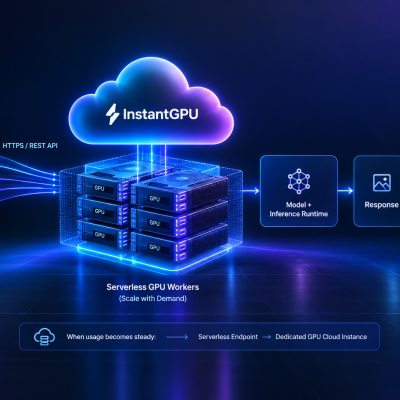
Serverless deploys inference or training functions from the same template library, or your own container, billing per second of execution. Workers scale to zero when idle and back up under load without manual capacity planning a Python function with a decorator, no YAML, no Kubernetes.
Built for product teams shipping inference APIs with unpredictable traffic, and for fast prototyping before committing to a dedicated instance.
Model APIs: skip infrastructure and GPU availability planning entirely
Production-ready endpoints across five modalities image, video, audio, language, embeddings testable live in a playground before writing any integration code. This tier removes the GPU availability question from your side of the equation altogether.
Real Pricing Across 100+ GPU Types
| GPU | VRAM | Best For | $/hr From |
| NVIDIA B200 | 179GB | Frontier LLM training & long-context inference | $6.25/hr |
| NVIDIA H200 NVL | 140GB | Frontier LLM training & long-context inference | $3.21/hr |
| NVIDIA H100 SXM | 80GB | Large model training & high-throughput inference | $2.82/hr |
| NVIDIA H100 PCIe | 80GB | Large model training & high-throughput inference | $2.47/hr |
| NVIDIA A100 PCIe | 80GB | Large model training & high-throughput inference | $1.59/hr |
| NVIDIA A100 SXM4 | 40GB | Fine-tuning, mid-size training, inference | $0.696/hr |
| NVIDIA L40S | 45GB | Fine-tuning, mid-size training, inference | $0.535/hr |
| NVIDIA RTX 4090 | 24GB | Image/video generation, mid-tier AI workloads | $0.513/hr |
Where Cold-Start Speed Fits In
Solving GPU availability answers “is there a GPU at all.” How fast that GPU is ready to serve traffic once allocated is a related, second-order question — and it’s the problem platforms like Modal have focused deep engineering effort on solving through checkpoint/restore architecture.
On InstantGPU.ai’s Serverless tier today: per-second billing with automatic scale-to-zero means no idle cost between requests; template-based deploys avoid building an environment from scratch; and cached, layer-reused builds speed up the deploy pipeline itself.
What we haven’t published yet is a hard cold-start-latency number for a request-triggered scale-up event. [Insert real measured benchmark here once available mean/median seconds from a scaled-to-zero Serverless function to first response, by model size]. We’d rather publish that gap honestly than manufacture a number.
InstantGPU vs. Going Direct vs. Modal
| InstantGPU.ai | Direct (Different providers) | Modal | |
| GPU availability model | Multi-cloud, pooled, auto-migrated | Single provider, self-managed risk | Single cloud (Modal-operated) |
| Automatic migration on unavailability | Yes | No | N/A |
| GPU type variety | 100+ across providers | Limited to that provider’s fleet | Curated set |
| Billing | Per-hour (GPU Cloud) / per-second (Serverless) | Varies | Per-second |
| Cold-start optimization | [Publish once benchmarked] | Generally unoptimized | Deep checkpoint/restore engineering (published) |
| Best for | Teams prioritizing GPU availability + flexibility | Teams comfortable managing multi-vendor risk | Teams prioritizing cold-start speed on one managed cloud |
The Bottom Line
Most of the conversation around serverless GPU infrastructure centers on cold-start speed. That’s a real problem. But it assumes you can get the GPU you need in the first place and for the highest-demand hardware, that assumption fails often enough to be the actual bottleneck for most teams.
InstantGPU.ai solves GPU availability one layer earlier: pool capacity across providers, monitor it continuously, and migrate automatically the moment something breaks — so availability stops being something you manage yourself. Cold-start numbers are the next thing we’ll publish, once we have benchmarks worth standing behind.
[Start Deploying →]
GPU Availability FAQ’s
GPU availability is whether a specific GPU type is actually obtainable in your region at the moment you need it, not merely advertised as in stock. High-demand hardware like H100s and H200s frequently shifts from available to limited to unavailable, making this a routine planning risk rather than an edge case.
By continuously monitoring every connected provider for capacity and health, and automatically migrating a workload to an equivalent GPU the moment the current one becomes unavailable — with no manual intervention required.
The system detects it, searches connected providers in your region for an equivalent, and migrates you automatically if one is found. If nothing equivalent is available, you're notified immediately with alternatives.
GPU Cloud is a dedicated, always-on instance with full SSH access and persistent storage, billed per hour. Serverless is event-driven, scales to zero when idle, and bills per second — better suited to inference with unpredictable traffic.
100+ GPU types with live pricing, from entry-level cards to frontier hardware like the H200 and B200, sourced across the connected provider network.