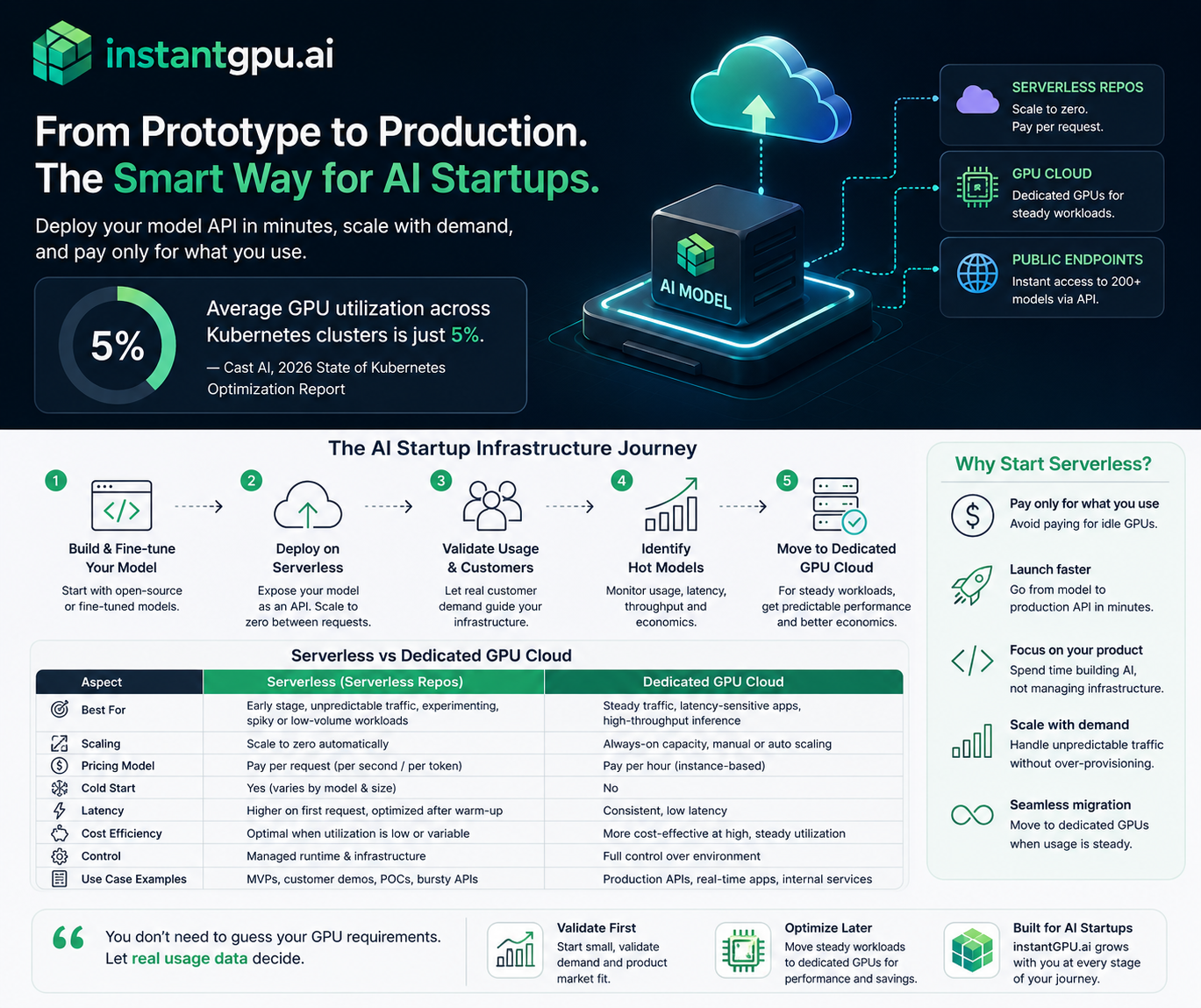
AI startups need inference infrastructure before they need infrastructure teams
For an early-stage AI startup, getting a model into production is only the beginning. The next challenge is making that model available through a reliable API while customer usage is still uncertain. Buying or reserving dedicated GPU capacity too early can leave expensive compute sitting idle; building the entire GPU serving stack internally can consume engineering time that would otherwise go toward the product.
InstantGPU provides a path between those two extremes. A startup can deploy an open-source or fine-tuned model as a Serverless endpoint, let infrastructure scale with demand during the validation stage, and move a consistently busy model to dedicated GPU Cloud capacity when the economics and performance requirements justify it.
The industry data behind the problem
5% — average GPU utilization measured by Cast AI across the Kubernetes clusters included in its 2026 State of Kubernetes Optimization Report.
Cast AI analyzed tens of thousands of Kubernetes clusters across AWS, Google Cloud and Microsoft Azure. Its reported average GPU utilization was only 5%. The report notes that this corresponds to roughly 20 times as much provisioned GPU capacity as workloads were consuming at a given moment. This is not a statistic specifically about AI startups or Serverless platforms; it is a broader production-Kubernetes benchmark. It is useful here because it illustrates the economic risk of provisioning GPU capacity for peak or uncertain demand.
10–200× — latency improvement reported by the ServerlessLLM research system over state-of-the-art serverless systems across evaluated LLM inference workloads.
The ServerlessLLM paper, published in 2024, addresses one of the central technical challenges of serverless LLM inference: loading large model checkpoints and starting inference quickly. Its evaluation reported 10–200× lower latency than state-of-the-art serverless systems across the workloads it tested. This is a research result for that system and should not be interpreted as a guaranteed InstantGPU performance figure.
6–8× — startup-time reduction discussed in a 2024 review of serverless LLM inference techniques for the ServerlessLLM approach.
Cold starts remain an important consideration for GPU serverless workloads. A 2024 review of serverless inference describes ServerlessLLM’s multi-tier checkpoint loading approach as reducing startup time by approximately 6–8× compared with conventional loading approaches. Again, this is published research rather than an InstantGPU SLA or product benchmark.
The problem: your customers arrive before your traffic does
Suppose an AI startup has fine-tuned an open-source language model for a specific vertical. The model is ready, the application is ready, and the team needs an API for its first customers.
At this stage, usage may look like this:
- A handful of API requests during development and testing.
- A few hundred requests on one day after a customer launch.
- Very little traffic overnight.
- A sudden burst when a new customer integrates the API.
- Several models being tested before the startup decides which one will become the primary production model.
The infrastructure decision is therefore difficult. Provision for the average and risk running out of capacity at the wrong time. Provision for the peak and pay for resources that may remain idle. Or build an autoscaling GPU platform internally and take on another infrastructure project before product-market fit is proven.
The solution: start serverless, then graduate to dedicated GPU Cloud
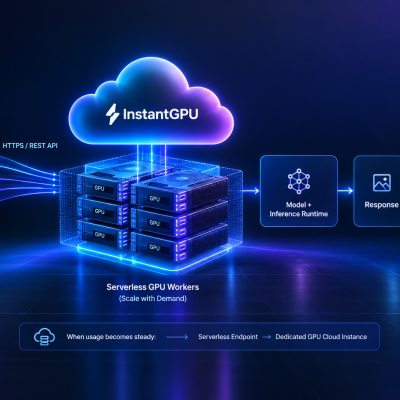
InstantGPU is designed around a simple progression: use elastic Serverless infrastructure when demand is uncertain, then use dedicated GPU capacity when demand becomes predictable.
Stage 1 — Deploy the model as a Serverless endpoint
The startup deploys its open-source or fine-tuned model from an InstantGPU template or repository. The application logic remains focused on inference rather than on assembling GPU infrastructure.
- Package the model and inference handler.
- Use a suitable serving stack or template, such as a production-ready vLLM-based inference service where appropriate.
- Expose the model through an API endpoint.
- Configure scaling around actual demand.
Stage 2 — Scale with customer demand
During early traction, demand is often intermittent. InstantGPU’s Serverless offering is designed to burst from zero based on workload demand, so the startup does not have to keep a dedicated GPU worker running simply because another request might arrive later.
The distinction matters: scale-to-zero does not mean zero latency. A cold start can introduce startup overhead when a model is not already warm. That trade-off should be considered explicitly for latency-sensitive applications. Published research on serverless LLM inference exists precisely because model loading and GPU initialization are significant engineering challenges.
Stage 3 — Move consistently hot models to dedicated GPU Cloud
Eventually, a model may become consistently busy. Requests arrive throughout the day, latency becomes more important, and the startup can forecast its compute requirement with greater confidence.
That is the point at which a dedicated GPU instance can make more sense. Instead of paying the operational and latency trade-offs of repeatedly starting serverless workers, the startup can keep the model warm on dedicated GPU capacity and optimize around sustained throughput and predictable traffic.
AI startups need inference infrastructure before they need infrastructure teams
|
Business stage
|
Traffic pattern
|
Recommended deployment
|
Primary objective
|
|---|---|---|---|
Serverless vs. Dedicated GPU Cloud
Neither deployment model is universally better. The right choice depends on traffic shape, latency requirements, model size, concurrency, and how predictable the workload has become.
|
Factor
|
Serverless GPU
|
Dedicated GPU Cloud
|
|---|---|---|
Reference architecture
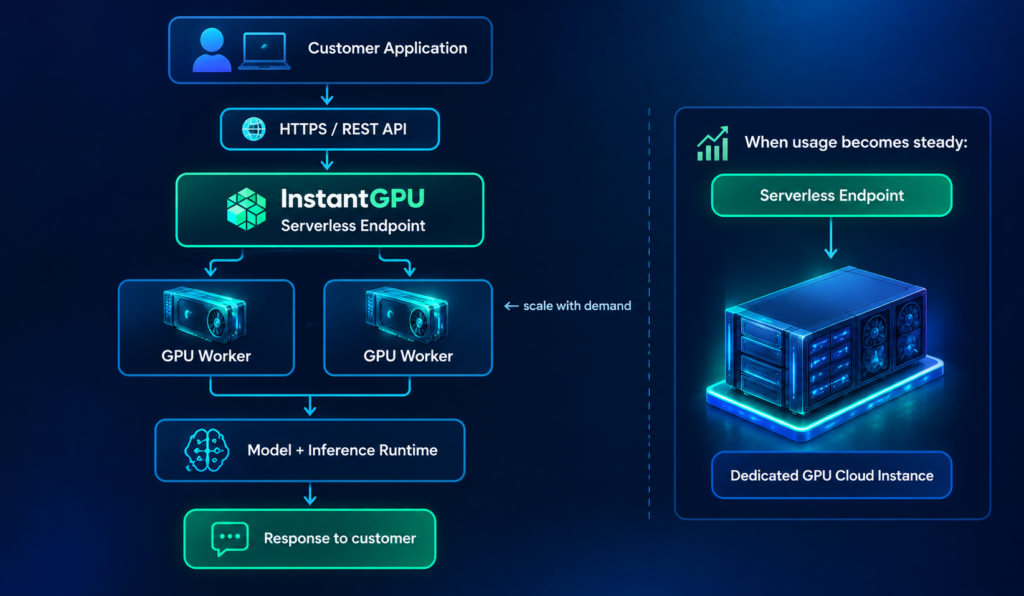
The important architectural property is that the application is separated from the underlying GPU capacity. The startup integrates against an API rather than making its customer-facing product dependent on a particular GPU machine.
What AI startups can host
- Fine-tuned large language models for domain-specific copilots.
- Open-source LLMs exposed through OpenAI-compatible APIs.
- Text embedding and reranking services for RAG applications.
- Image generation and image transformation models.
- Speech recognition and transcription models.
- Vision-language models for document, image and video understanding.
- Custom inference pipelines that combine multiple models.
For startups that do not need to deploy their own model, InstantGPU also provides public model endpoints. That can remove deployment work altogether for supported models and let the startup integrate an API first, then move to a custom Serverless deployment when model customization becomes important.
When should a startup move from Serverless to dedicated GPU?
There is no responsible universal threshold such as ‘move after X requests per day.’ The break-even point depends on GPU type, model size, inference duration, batching, concurrency, pricing, cold-start behavior, and the startup’s latency SLO.
Instead, monitor these signals:
- GPU worker utilization is consistently high rather than occasional.
- Requests arrive frequently enough that keeping the model warm has clear value.
- Cold-start latency materially affects customer experience.
- Traffic can be forecast with reasonable confidence.
- Monthly serverless spend approaches the cost of an appropriately sized dedicated instance.
- A single model has become a stable production workload rather than an experiment.
The correct calculation is not simply GPU price versus request price. A startup should compare total inference economics, including GPU time, model loading, concurrency, batching, latency requirements, storage, data transfer where applicable, and the engineering cost of operating the stack.
What the published evidence tells us
The case for elastic GPU infrastructure is not based on a claim that every GPU workload should be serverless. The published evidence points to a more nuanced conclusion: GPU capacity is expensive, utilization can be surprisingly low, and serverless inference has genuine technical challenges that need to be engineered around.
- Cast AI’s 2026 report found 5% average GPU utilization across the Kubernetes clusters it analyzed, with the result consistent across AWS, Google Cloud and Azure. The report’s methodology covered production telemetry from tens of thousands of clusters.
- The same report explains that 5% utilization implies roughly 20× as much provisioned GPU capacity as workloads were consuming at any given moment. This is a broad Kubernetes benchmark, not an AI-startup-specific statistic.
- The ServerlessLLM research paper reported 10–200× latency reductions over state-of-the-art serverless systems across its evaluated LLM workloads, demonstrating that model loading and startup are central optimization targets in serverless inference.
- A 2024 review of serverless LLM inference described the ServerlessLLM approach as reducing startup time by roughly 6–8× through multi-tier checkpoint loading. This is a research result, not an InstantGPU performance guarantee.
Why InstantGPU fits this startup journey
InstantGPU brings the two deployment modes into one platform: GPU Cloud for dedicated compute and Serverless for workloads that need elastic execution. Its website also describes public endpoints for calling supported models directly without deploying infrastructure.
- Serverless repositories for pushing AI code and deploying inference workloads.
- Automatic containerization and infrastructure handling for supported Serverless workflows.
- Burst-to-zero scaling for workloads with intermittent demand.
- Dedicated GPU instances for workloads that need persistent, dedicated capacity.
- Public model endpoints for teams that want to consume models without operating their own deployment.
- A progression from experimentation to production without forcing the startup to change GPU infrastructure providers as its workload matures.
Example: a fine-tuned customer-support model
Consider an AI startup that has fine-tuned an open-source model for customer-support automation. Its SaaS product sends customer messages to the model through an internal inference API.
During the first few weeks:
- The team is onboarding its first customers.
- Traffic is intermittent.
- The model may receive long periods with no requests.
- The startup is still changing prompts, model versions and inference parameters.
A Serverless deployment lets the team validate the product without treating a permanently allocated GPU as a prerequisite for every stage of the experiment.
Six months later, the picture may be different:
- The same model serves thousands of customer interactions every day.
- Requests are distributed consistently across business hours.
- The startup has established latency and throughput targets.
- Model traffic can be forecast from historical usage.
At that point, keeping a dedicated GPU instance warm may be the better architecture. The startup can optimize the model for continuous serving, use batching where appropriate, and measure throughput against a predictable capacity baseline.
What about public model endpoints?
Not every startup needs to deploy its own model immediately. If the product can use an existing model, a public endpoint can be the fastest route to validating the application.
- Public endpoint → fastest path when a supported model already meets requirements.
- Serverless endpoint → best when the startup needs its own model, fine-tuning, custom code or inference pipeline.
- Dedicated GPU Cloud → best when the workload has become consistently active and performance/cost predictability justify dedicated capacity.
Implementation checklist for an AI startup
- Choose the model and confirm GPU memory requirements.
- Decide whether an InstantGPU public endpoint can meet the initial product requirement.
- If custom deployment is needed, select a Serverless template or package the inference code.
- Define the API contract before exposing the endpoint to customers.
- Set authentication, rate limits and observability appropriate to the application.
- Measure request volume, latency, queue time, cold-start frequency and GPU utilization.
- Track model-specific economics rather than looking only at raw GPU-hour price.
- Review the deployment periodically as traffic becomes more predictable.
- Move consistently hot workloads to dedicated GPU Cloud capacity when the data supports the change.
From first API call to production GPU infrastructure
The infrastructure needs of an AI startup change quickly. In the beginning, the biggest risk is often paying for infrastructure before demand exists. Later, the bigger risk can become insufficient capacity, unpredictable latency, or paying a premium for highly elastic infrastructure when a workload has become consistently active.
That is why the most practical architecture is not ‘Serverless versus dedicated GPU.’ It is a progression.
Validate → Deploy Serverless → Scale with demand → Measure → Move hot workloads to Dedicated GPU
InstantGPU gives AI startups a way to follow that progression on a single platform: use Serverless infrastructure when usage is uncertain, dedicated GPU Cloud when workloads become steady, and public endpoints when deploying a model is unnecessary.
The goal is simple: spend engineering effort building the AI product—not building the GPU infrastructure underneath it.
Start hosting your AI model
Explore InstantGPU: https://instantgpu.ai
Deploy a model, expose an inference API, and scale your infrastructure as your customers—not your infrastructure budget—determines what you need.
Sources and published research
- Cast AI — 2026 State of Kubernetes Optimization Report — Industry telemetry across tens of thousands of Kubernetes clusters; reported 5% average GPU utilization and methodology.
- Cast AI — 2026 State of Kubernetes Optimization Report press release — Published April 21, 2026; summarizes the 5% GPU utilization finding.
- ServerlessLLM: Low-Latency Serverless Inference for Large Language Models — 2024 research paper; reports 10–200× latency improvement versus state-of-the-art serverless systems in evaluated workloads.
- Enabling Efficient Serverless Inference Serving for LLM in the Cloud — 2024 review discussing cold-start latency and the ServerlessLLM approach, including 6–8× startup-time reduction.
- NVIDIA Inference Reference Architecture — Reference architecture for cloud-native AI inference services and GPU infrastructure.
- InstantGPU — InstantGPU product information used for the platform-specific descriptions in this article.
Editorial / publishing note
The numerical claims in this article are intentionally attributed to external published sources. The 5% GPU-utilization figure is from Cast AI’s analysis of Kubernetes clusters and should not be presented as a universal utilization rate for all GPU infrastructure. The 10–200× and 6–8× figures are results reported for specific research systems/approaches. They should not be presented as guaranteed InstantGPU performance or savings. Product-specific claims should be updated against the live InstantGPU documentation before publication.