

What a Truly Serverless GPU Platform Actually Looks Like
In short: a lot of platforms call themselves “serverless” while still charging for idle time, or scaling up fast but back down slowly. A truly serverless GPU platform does three things at once — scales to zero with no idle cost, comes back from zero fast enough that users don’t notice, and does it consistently across its whole catalog, not just one flagship product. This piece defines what a truly serverless GPU platform should mean, and looks at where InstantGPU’s published numbers do and don’t meet that bar.
Serverless" gets used loosely — here's a stricter definition
Plenty of GPU platforms market themselves as serverless because they offer autoscaling. That’s necessary but not sufficient. A genuinely serverless GPU platform needs to satisfy three conditions together:
- No idle cost. You pay for GPU-seconds (or generations, or tokens) actually used — nothing while a worker is scaled to zero.
- Fast enough cold starts that scale-to-zero is actually usable. If bringing a GPU back from zero takes tens of seconds or minutes, teams end up keeping workers warm (and paying for them) just to avoid the wait — which quietly defeats the point of serverless pricing.
- Consistency, not just a best case. A platform that’s fast on one showcase model but slow everywhere else isn’t a truly serverless GPU platform — it’s one fast product with a serverless label on the rest.
A platform that’s slow on any one of these is “serverless” in name but not in practice — you end up either paying for idle time somewhere, waiting on cold starts somewhere, or both.
Where InstantGPU's published numbers land against a truly serverless GPU bar
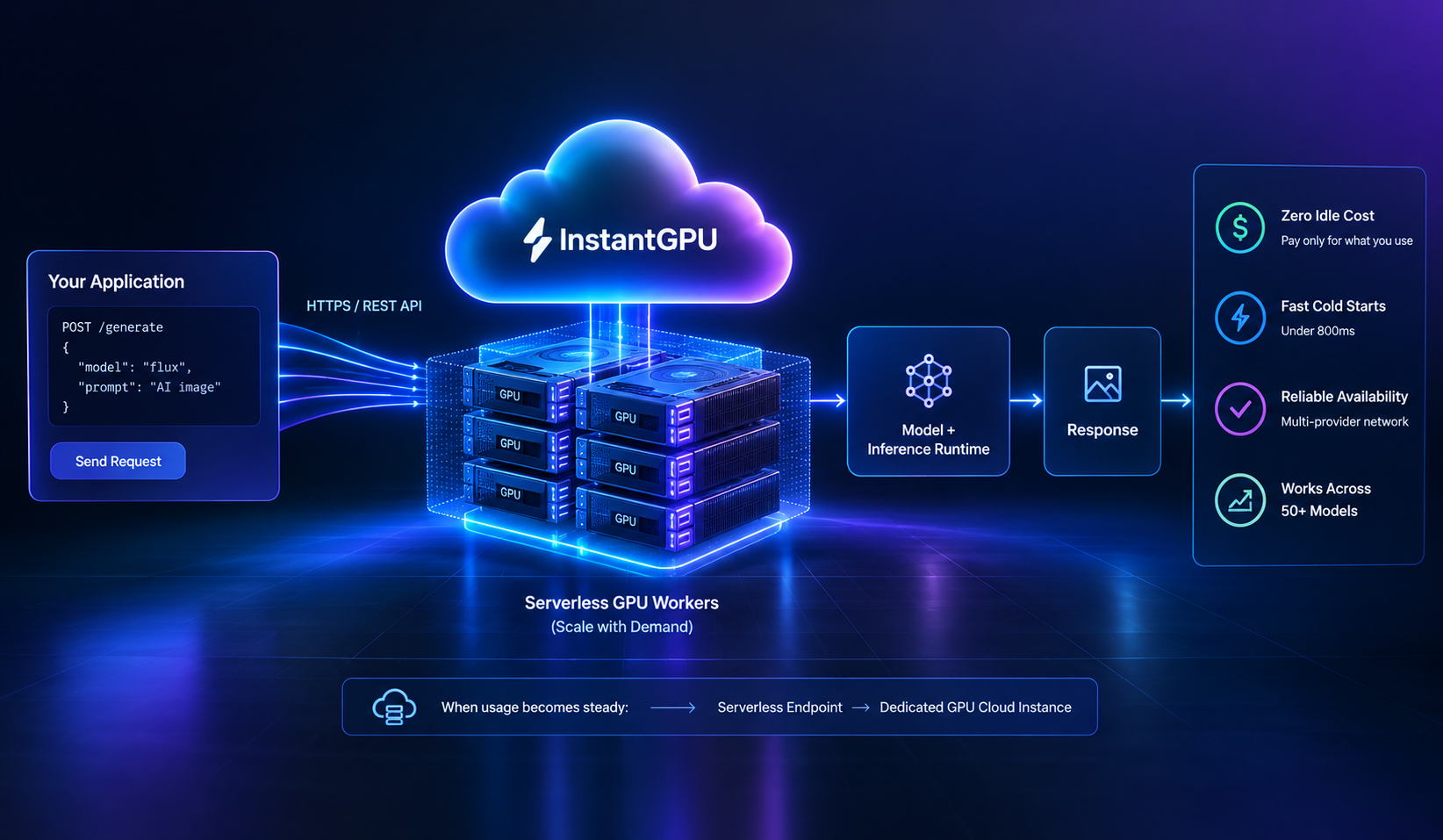
On condition 1 (no idle cost): InstantGPU’s model API endpoints bill strictly per generation or token used, and the serverless GPU tier scales workers to zero when idle with no charge while nothing is running. Platform pricing starts from $0.39/hr for workloads that do run, with a published 99.99% uptime SLA.
On condition 2 (fast enough cold starts): InstantGPU publishes cold starts under 800 milliseconds across its model API endpoints. That’s the number that actually matters for whether scale-to-zero is usable — sub-second is fast enough that most users won’t perceive a wait, which is the practical bar a cold start has to clear to count as “truly” serverless rather than serverless-with-a-catch.
Consistency Across Models and Endpoints
On condition 3 (consistency, not just a best case): this is the condition worth checking most carefully, because it’s where a lot of “serverless” marketing quietly narrows to one flagship number. InstantGPU states the under-800ms figure applies across all endpoints — more than 50 models spanning image, video, audio, and language, not a single showcase product. The published catalog shows the range this covers: image models like Flux Schnell and GPT-Image 1.5 at roughly 1.2 seconds total estimated latency, up to a larger text-to-video model like Veo 3.1 at roughly 4.5 seconds — different total response times depending on how much computation each model actually does, sitting on top of the same sub-800ms cold-start floor.
InstantGPU also publishes a more specific, cluster-level figure for its GPU-accelerated video generation product: H100 clusters warming up in under 1.8 seconds, with 640GB of pooled HBM3 memory shared across eight H100s over NVLink 4.0 so large models don’t reload from scratch between requests.
All of the figures above are InstantGPU’s own published numbers, not independently audited third-party benchmarks. Treat them as a starting reference point — test them against your own model and traffic pattern before relying on them for a production decision.
The part "truly serverless" claims usually leave out: availability
Speed and zero-idle-cost billing are the two conditions most “serverless” marketing focuses on. There’s a third, quieter requirement that matters just as much in production: the GPU has to actually be there when a cold-start request needs one. A sub-second warm-up is only useful as often as the underlying capacity is available to warm up in the first place.
This is the condition a truly serverless GPU platform can’t skip, and it’s where InstantGPU’s architecture does something structurally different from a single-data-center platform: because it sources capacity from a network of GPU providers rather than one provider’s inventory, it continuously monitors instance health and availability, and automatically migrates a workload to another provider in its network if a GPU becomes unhealthy or unavailable — notifying the user only if nothing equivalent can be found. A fast cold start on a GPU that isn’t there doesn’t help; this is the piece that makes the speed numbers dependable rather than best-case.
The same “don’t make the user wait on infrastructure” principle shows up on a different product entirely: InstantGPU’s dedicated GPU Cloud tier provisions bare-metal instances in under 60 seconds with no queue. It’s solving a different problem — GPU Cloud is for persistent, dedicated workloads rather than on-demand serverless ones — but it’s the same underlying design instinct applied to a different part of the platform.
What we can't tell you
In the interest of not overstating what “truly serverless” means here: InstantGPU hasn’t published the specific internal engineering techniques behind its cold-start numbers. The broader industry generally approaches this class of problem with some combination of capacity buffering, lazy container or filesystem loading, and process or GPU-memory snapshotting — but we can’t confirm which of these, if any, make up InstantGPU’s actual implementation without inventing a level of detail that isn’t publicly available. If that matters for your evaluation, it’s a fair, specific question to put to the InstantGPU team directly.
The takeaway
“Truly serverless” should mean more than autoscaling — it means no idle cost, cold starts fast enough to make scale-to-zero practical rather than theoretical, and that speed holding across a real catalog, not just a flagship model, backed by capacity that’s actually available when needed. On InstantGPU’s own published numbers, the platform meets that bar at the figures given: sub-800ms cold starts across 50+ models, zero idle billing, and a provider network built to keep that speed dependable rather than occasional. See InstantGPU’s model API pricing to test it against your own workload.