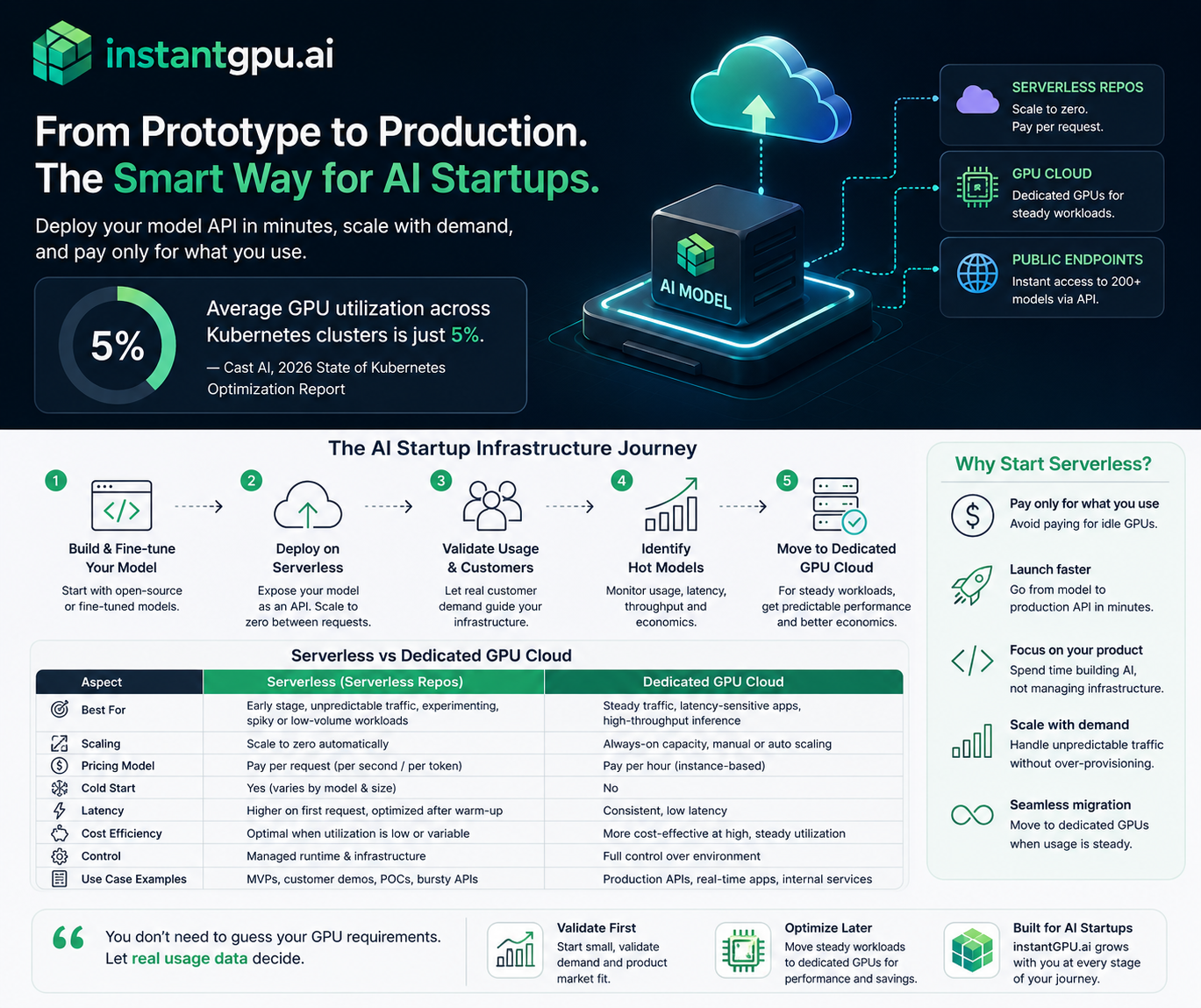
AI startups need inference infrastructure before they need infrastructure teams For an early-stage AI startup, getting a model into production is only the beginning. The next challenge is making that model available through a reliable API while customer usage is still uncertain. Buying or reserving dedicated GPU capacity too early can leave expensive compute sitting idle; building the entire GPU serving stack internally can consume engineering time that would otherwise go toward the product. InstantGPU provides a path between those two extremes. A startup can deploy an open-source or fine-tuned model as a Serverless endpoint, let infrastructure scale with demand during the validation stage, and move a consistently busy model to dedicated GPU Cloud capacity when the economics and performance requirements justify it. The industry data behind the problem 5% — average GPU utilization measured by Cast AI across the Kubernetes clusters included in its 2026 State of Kubernetes Optimization Report. Cast AI analyzed tens of thousands of Kubernetes clusters across AWS, Google Cloud and Microsoft Azure. Its reported average GPU utilization was only 5%. The report notes that this corresponds to roughly 20 times as much provisioned GPU capacity as workloads were consuming at a given moment. This is not a statistic specifically about AI startups or Serverless platforms; it is a broader production-Kubernetes benchmark. It is useful here because it illustrates the economic risk of provisioning GPU capacity for peak or uncertain demand. 10–200× — latency improvement reported by the ServerlessLLM research system over state-of-the-art serverless systems across evaluated LLM inference workloads. The ServerlessLLM paper, published in 2024, addresses one of the central technical challenges of serverless LLM inference: loading large model checkpoints and starting inference quickly. Its evaluation reported 10–200× lower latency than state-of-the-art serverless systems across the workloads it tested. This is a research result for that system and should not be interpreted as a guaranteed InstantGPU performance figure. 6–8× — startup-time reduction discussed in a 2024 review of serverless LLM inference techniques for the ServerlessLLM approach. Cold starts remain an important consideration for GPU serverless workloads. A 2024 review of serverless inference describes ServerlessLLM’s multi-tier checkpoint loading approach as reducing startup time by approximately 6–8× compared with conventional loading approaches. Again, this is published research rather than an InstantGPU SLA or product benchmark. The problem: your customers arrive before your traffic does Suppose an AI startup has fine-tuned an open-source language model for a specific vertical. The model is ready, the application is ready, and the team needs an API for its first customers. At this stage, usage may look like this: A handful of API requests during development and testing. A few hundred requests on one day after a customer launch. Very little traffic overnight. A sudden burst when a new customer integrates the API. Several models being tested before the startup decides which one will become the primary production model. The infrastructure decision is therefore difficult. Provision for the average and risk running out of capacity at the wrong time. Provision for the peak and pay for resources that may remain idle. Or build an autoscaling GPU platform internally and take on another infrastructure project before product-market fit is proven. The solution: start serverless, then graduate to dedicated GPU Cloud InstantGPU is designed around a simple progression: use elastic Serverless infrastructure when demand is uncertain, then use dedicated GPU capacity when demand becomes predictable. Stage 1 — Deploy the model as a Serverless endpoint The startup deploys its open-source or fine-tuned model from an InstantGPU template or repository. The application logic remains focused on inference rather than on assembling GPU infrastructure. Package the model and inference handler. Use a suitable serving stack or template, such as a production-ready vLLM-based inference service where appropriate. Expose the model through an API endpoint. Configure scaling around actual demand. Stage 2 — Scale with customer demand During early traction, demand is often intermittent. InstantGPU’s Serverless offering is designed to burst from zero based on workload demand, so the startup does not have to keep a dedicated GPU worker running simply because another request might arrive later. The distinction matters: scale-to-zero does not mean zero latency. A cold start can introduce startup overhead when a model is not already warm. That trade-off should be considered explicitly for latency-sensitive applications. Published research on serverless LLM inference exists precisely because model loading and GPU initialization are significant engineering challenges. Stage 3 — Move consistently hot models to dedicated GPU Cloud Eventually, a model may become consistently busy. Requests arrive throughout the day, latency becomes more important, and the startup can forecast its compute requirement with greater confidence. That is the point at which a dedicated GPU instance can make more sense. Instead of paying the operational and latency trade-offs of repeatedly starting serverless workers, the startup can keep the model warm on dedicated GPU capacity and optimize around sustained throughput and predictable traffic. AI startups need inference infrastructure before they need infrastructure teams Business stage Traffic pattern Recommended deployment Primary objective Prototype / private beta Low and unpredictable Serverless Get the API live quickly Early customer traction Spiky / intermittent Serverless with autoscaling Avoid paying for idle capacity Growing usage Increasing and increasingly predictable Serverless + dedicated for hot workloads Balance elasticity and latency Steady production workload High and sustained Dedicated GPU Cloud Maximize predictable throughput Serverless vs. Dedicated GPU Cloud Neither deployment model is universally better. The right choice depends on traffic shape, latency requirements, model size, concurrency, and how predictable the workload has become. Factor Serverless GPU Dedicated GPU Cloud Best fit Early-stage and variable workloads Steady, high-utilization workloads Capacity Elastic; workers can scale with demand Reserved/dedicated capacity Idle periods Can scale to zero GPU remains provisioned Cold starts Possible when capacity is not warm Avoided when model stays loaded Traffic predictability Works well when uncertain Traffic predictability Works well when uncertain Best when demand is predictable Latency Must account for startup/warm-up behavior More consistent for continuously served APIs Operational burden Infrastructure managed by platform More control,