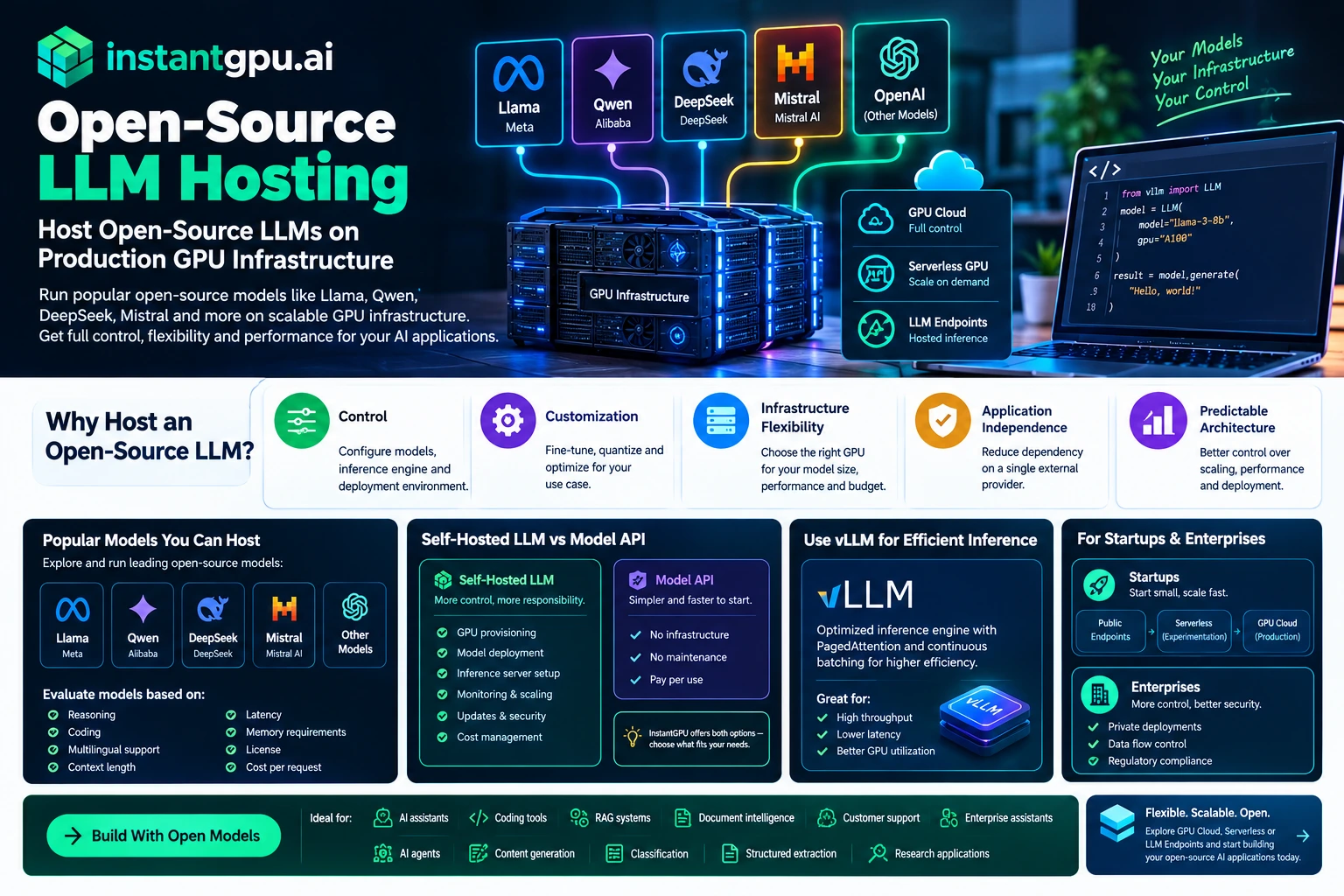
OPEN-SOURCE LLM HOSTING Host Open-Source LLMs on Production GPU Infrastructure Open-source and openly available language models have changed how developers build AI applications. Instead of relying exclusively on proprietary model APIs, teams can deploy compatible models themselves, customize inference settings, fine-tune model weights and maintain greater control over the application architecture. But running an open-source LLM in production still requires GPU infrastructure. Open-source LLM hosting gives developers the compute environment needed to run models such as Llama, Qwen, DeepSeek, Mistral and other compatible models. InstantGPU provides GPU Cloud, Serverless GPU and hosted model endpoints so teams can choose between infrastructure control and managed inference. Why Host an Open-Source LLM? There are several reasons developers choose to host their own models. Control You control the model configuration, inference engine and deployment environment. Customization Open models can be adapted through prompting, fine-tuning, quantization and other optimization techniques. Infrastructure Flexibility You can select GPUs based on model size, performance and budget rather than being restricted to the infrastructure exposed by a single model API. Application Independence Hosting your own model can reduce dependency on a single external AI provider. Predictable Architecture For production applications, owning the inference layer can give engineering teams more control over deployment, scaling and performance. What GPUs Do Open-Source LLMs Need? GPU requirements depend on several factors: Model parameter count Quantization Precision Context length Batch size Concurrent users Target latency KV-cache requirements A small quantized model may be suitable for a single consumer or workstation-class GPU, while larger models can require high-memory GPUs or multiple GPUs. InstantGPU provides access to configurations ranging from cost-efficient GPUs for development and smaller inference workloads to high-memory GPUs for larger models. Host Llama, Qwen, DeepSeek and Other Models One of the biggest advantages of an open model ecosystem is choice. Teams can evaluate models based on: Reasoning Coding Multilingual performance Context length Latency Memory requirements License Cost per request The model that is best for one application may not be the best for another. InstantGPU’s infrastructure lets developers experiment with different models without having to redesign their entire cloud strategy every time. Self-Hosted LLM vs Model API A hosted model API is usually easier to start with. You send a request and receive a response. Self-hosting introduces additional responsibilities, including: GPU provisioning Model deployment Inference server configuration Monitoring Scaling Updates Security Cost management For developers who need infrastructure control, these responsibilities can be worthwhile. For teams that simply want model access, InstantGPU Public Endpoints can provide a simpler path. This makes it possible to choose the appropriate operating model rather than treating every AI workload identically. Using vLLM for Open-Source LLM Inference Modern LLM deployments frequently use optimized inference engines rather than directly executing model code for every request. vLLM is one widely used inference engine for open-source LLM serving. It includes techniques such as PagedAttention and continuous batching designed to improve serving efficiency. InstantGPU includes vLLM among its deployment templates, allowing developers to use established inference infrastructure rather than starting from an empty GPU environment. Open-Source LLM Hosting for AI Startups Startups often need to balance model quality, infrastructure cost and speed of development. A startup may begin by using a hosted API and later move selected workloads to self-hosted open models. A flexible GPU platform makes that transition easier. You can use: Public Endpoints → prototype Serverless → production experimentation GPU Cloud → dedicated production workloads This staged approach can prevent startups from prematurely building complex GPU infrastructure. Open-Source LLM Hosting for Enterprises Enterprises may choose open models because they need greater control over model deployment, data flows and infrastructure. Private deployments can be particularly relevant for applications involving proprietary information. However, organizations should separately evaluate the model’s license, security requirements, data-processing requirements and applicable regulations before deploying a model commercially. Why InstantGPU? InstantGPU combines access to GPU infrastructure with serverless deployment and hosted AI endpoints. The platform currently provides access to a broad range of GPU configurations and sources capacity across multiple providers. That means developers can select infrastructure based on workload requirements instead of being locked into a single GPU provider. Build With Open Models Open-source LLM hosting is useful for: AI assistants Coding tools RAG systems Document intelligence Customer support Internal enterprise assistants AI agents Content generation Classification Structured extraction Research applications Explore GPU Cloud for full control, Serverless for elastic deployments, or LLM Endpoints when you want API-based model access. FAQ’S Frequently Asked Questions What is open-source LLM hosting? Open-source LLM hosting means running an open or openly available language model on your own or managed GPU infrastructure so applications can access it for inference. Can I host Llama or Qwen on a GPU? Yes, provided the model and its license are compatible with your intended use and the GPU has sufficient memory and compute capacity. What GPU is needed to host an open-source LLM? There is no single answer. Model size, quantization, context length and concurrency determine the required GPU capacity. Is self-hosting cheaper than an API? It depends on utilization. High and predictable utilization can make dedicated GPU hosting attractive, while low or unpredictable traffic can favor serverless or API-based inference. Can I fine-tune an open-source LLM? Yes. Compatible models can be fine-tuned using techniques such as LoRA or QLoRA, subject to the model’s technical and licensing requirements. Open-source LLM hosting means running an open or openly available language model on your own or managed GPU infrastructure so applications can access it for inference. Yes, provided the model and its license are compatible with your intended use and the GPU has sufficient memory and compute capacity. There is no single answer. Model size, quantization, context length and concurrency determine the required GPU capacity. It depends on utilization. High and predictable utilization can make dedicated GPU hosting attractive, while low or unpredictable traffic can favor serverless or API-based inference. Yes. Compatible models can be fine-tuned using techniques such as LoRA or QLoRA, subject to the model’s technical and licensing requirements.